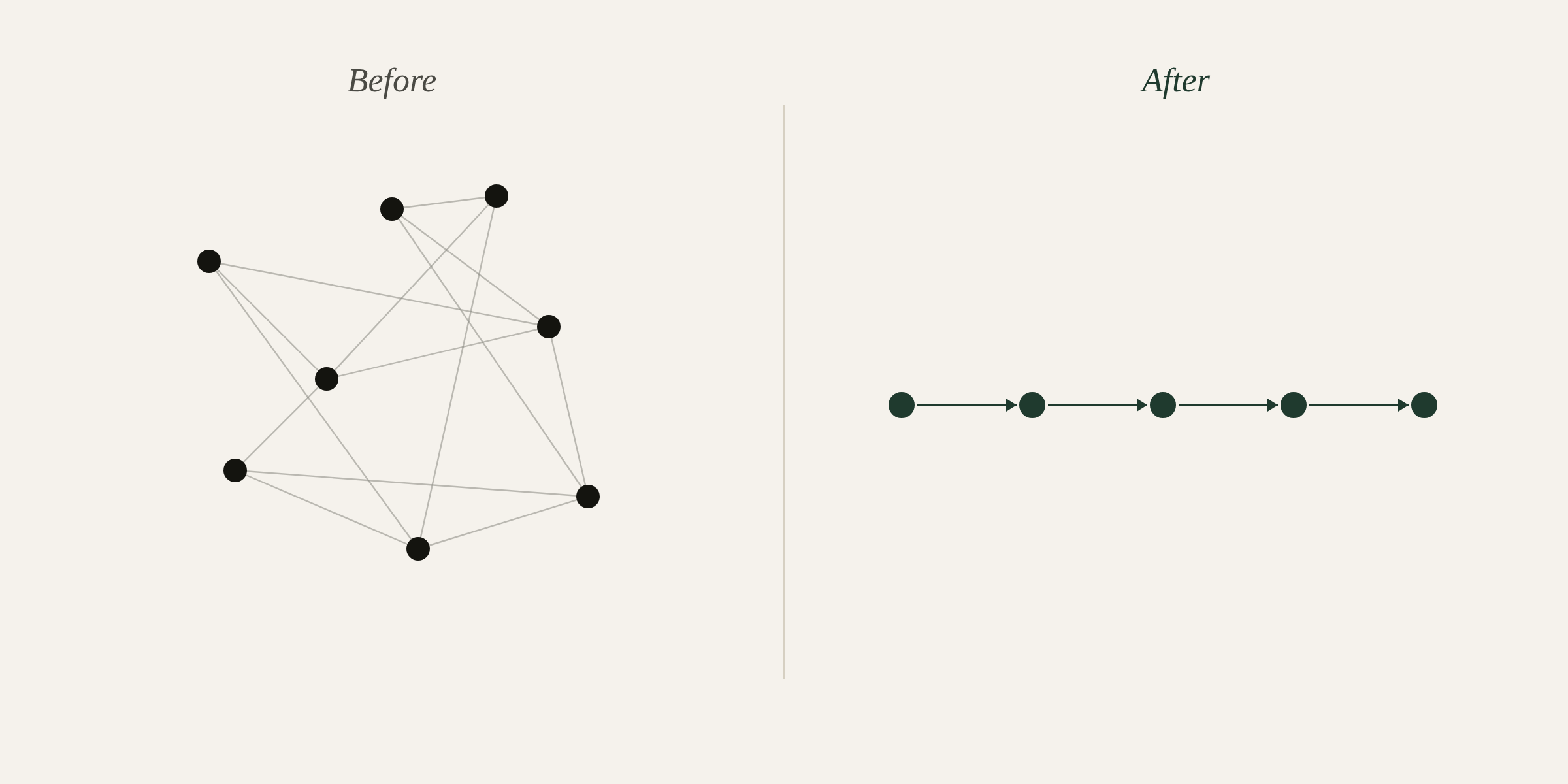
After you have reviewed enough businesses, you stop being surprised. The logos change. The industries change. The specific tools change. The problems do not.
Every business believes its chaos is unique. The owner will tell you, in the first meeting, that their situation is complicated, that their industry is different, that the usual playbooks do not apply to them. They are half right. The details are always specific. But the shape of the dysfunction is almost always the same, and once you have seen it enough times, you can spot it from across the room.
Here is what we keep finding.
The business runs on one person's memory.
There is always someone, often the owner, sometimes a long-tenured office manager, who is the operating system of the company. They know how every process actually works, which client needs special handling, what to do when the usual thing breaks. None of it is written down. It does not need to be, because they are always there.
Until they are not. They go on vacation and the business holds its breath. They get sick and things quietly fall apart. They threaten to leave and the owner realizes, with a jolt, that the company cannot function without one human's undocumented knowledge. This is the most common single point of failure in small business, and almost nobody treats it as the emergency it is.
Critical knowledge living in one person's head is not a staffing situation. It is an operational risk.
Work moves between people through gaps, not handoffs.
In a designed operation, work passes from one person to the next with a clear trigger, a clear owner, and a clear definition of done. In most businesses we see, work passes from one person to the next through a Slack message, a hallway conversation, or an assumption that someone else has it handled.
The result is the dropped handoff. The lead nobody followed up on. The client request that two people each thought the other was handling. The invoice that went out late because the trigger to send it lived in someone's head and that someone was busy. These are not people failing. These are gaps where a handoff should have been, and the work falls through the gap exactly as designed, because nobody designed it not to.
The software stack grew by accumulation.
No one sat down and chose the tools the business runs on. They accumulated. A CRM someone signed up for in 2019. A project tool a former employee liked. Three different places customer information lives, none of them complete. A subscription nobody can remember the purpose of but everyone is afraid to cancel.
The owner suspects they are paying for too much software and using too little of it. They are right. But the real cost is not the subscriptions. It is the friction of work spread across tools that do not talk to each other, the data entered three times, the reports assembled by hand because no single system holds the whole picture.
Automation got bolted onto broken processes.
The businesses that have tried to modernize often made it worse. They bought an automation tool, or hired someone to "add AI," and pointed it at a process that was never designed in the first place. Now the broken process runs faster. The bad handoff is automated. The unclear step is unclear at scale.
This is the trap of tools-first thinking, and it is everywhere right now because every vendor is selling AI as if the tool is the answer. The tool is never the answer. The tool is what you reach for after you have redesigned the workflow, not instead of it.
Everyone is working around the system instead of through it.
The clearest sign that an operation needs redesigning is the quiet workaround. The spreadsheet someone keeps on the side because the official system is too painful. The personal notes a salesperson keeps because the CRM does not fit how they actually work. The shadow process that exists because the real process does not serve the people doing the work.
When you find the workarounds, you have found the truth about how the business actually runs, which is almost never how the org chart or the software vendor says it runs. The workarounds are not the problem. They are the symptom, and they are usually the smartest thing happening in the building, because they are the only part that was designed by someone who actually does the work.
What it all means.
None of these are technology problems. They are design problems. The business was never designed; it accumulated, the way a house accumulates clutter, one reasonable decision at a time until the whole thing is hard to move through. Every individual choice made sense when it was made. The sum of them is an operation that costs the owner time, money, and sleep.
The good news in all of this is the same as the bad news: because the patterns repeat, they are recognizable, and because they are recognizable, they are fixable. We are not walking into each business and inventing a solution from nothing. We are walking in, recognizing the shape of the problem within the first week, and applying a method we have used before. That is what experience buys. Not a guarantee, but pattern recognition, and pattern recognition is most of the battle.
If any of this sounds like your business, it is not because your business is uniquely broken. It is because your business is normal, and normal businesses are full of friction nobody ever designed out. The first step is seeing it clearly. That is what we do.