You have probably heard the term. AI agents. Agent orchestration. Multi-agent systems. The language is everywhere right now, and most of it is written for engineers or investors, not for someone trying to figure out whether any of this is useful for their actual business.
This is the plain version.
Start with what an AI agent is.
An AI agent is not just a chatbot you type questions into. It is an AI system that can take a goal, break it into steps, and execute those steps on its own, including using tools, making decisions, and handing work off to the next step.
A simple example: instead of asking an AI a question and getting an answer, an agent might receive a customer inquiry, look up that customer's history in your CRM, draft a response based on what it finds, check whether a discount applies, and send the reply. All without you touching it.
That is meaningfully different from the AI tools most small businesses are using today. Those tools are excellent at one step at a time. Agents handle sequences.
So what is orchestration?
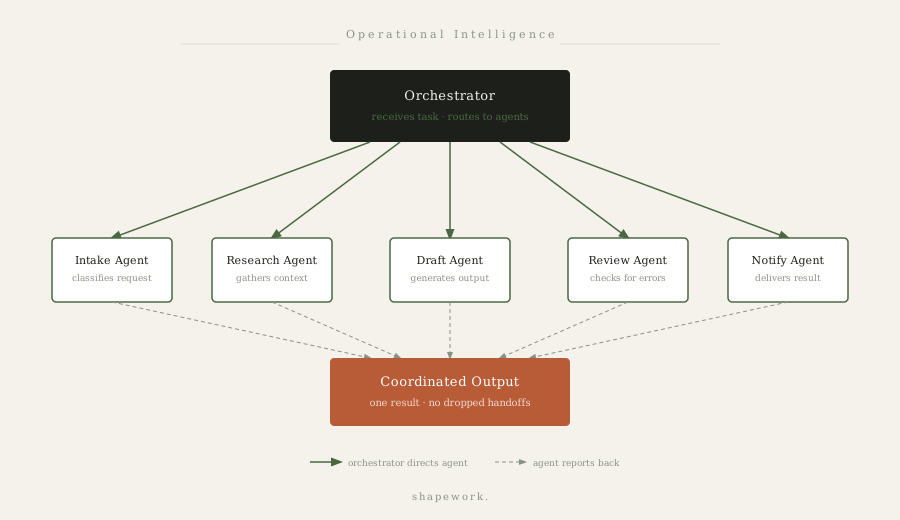
Orchestration is what happens when you have more than one agent and something needs to coordinate them.
Think of a business process with several distinct phases: intake, research, drafting, review, delivery. You could build one large AI system and try to make it handle all of that. Or you could build a smaller, focused agent for each phase and let an orchestrator manage the handoffs between them.
The orchestrator does not do the work. It decides which agent does the work, when, and in what order.
This is closer to how a well-run operation actually works. A good manager does not do every task themselves. They know who handles what, they set the sequence, they catch problems at handoffs, and they make sure the final output is coherent. An orchestrator does the same thing, but for AI agents.
Why does this matter for a small business owner?
Because the gap between "using AI" and "having AI work for you" is largely an orchestration problem.
Most owners who are experimenting with AI right now are doing something like this: they open a tool, type a prompt, copy the output, paste it somewhere else, do a manual step, open another tool, type another prompt. The AI is helpful, but a person is still managing every handoff. That person is often the owner.
Agent orchestration is what replaces that manual coordination. The handoffs happen automatically. The sequence runs without someone babysitting it. The owner gets a finished result instead of a pile of AI-assisted steps they still have to stitch together.
What kinds of workflows are good candidates?
Not everything should be orchestrated. The right candidates share a few characteristics: they are repeatable, they have at least three or four distinct phases, they happen often enough that the overhead is real, and a mistake is correctable. You would not start here with anything where an error has serious legal or financial consequences.
Common examples in owner-led businesses: new client onboarding sequences, inquiry response and qualification, weekly reporting, invoice follow-up, content review and publishing workflows, and internal knowledge retrieval.
What this is not.
Agent orchestration is not magic, and it is not a strategy. It is a technique. A well-designed workflow that uses orchestrated agents will work. A broken workflow with agents bolted onto it will fail faster and more expensively.
The work that matters most is upstream: understanding how a process actually runs, where the real friction is, and whether a given workflow is ready to be automated at all. That is the design problem. Orchestration is the implementation.
This is why we lead with workflow audit work rather than jumping straight to tooling. The question is never just whether we can build agents for something. It is whether we should, and whether this is the right thing to build them for.